

The Cheapest Way to Ship Packages as a Reseller (2026 Guide)
You scored a great deal, listed it, and it sold in an hour. Then you stood at the post office counter and watched $14 of your profit disappear into a shipping label.
Shipping is the quiet margin killer in reselling. Two flippers can sell the exact same item for the same price and walk away with very different profits, just because one of them knows the cheapest way to ship packages and the other pays whatever the counter says.
This guide breaks down how to pick the right service, shrink your box, and stop overpaying. No spreadsheets required.
Why Shipping Costs Matter More Than You Think
When you calculate your profit margins, shipping is the cost most people estimate instead of measure. That’s how a “$40 profit” flip turns into $26.
Here’s the thing: you don’t control the buyer’s zip code, but you control almost everything else. The carrier, the service level, the box size, where you buy the label, and whether you ship at all.
A few quick rules of thumb:
- Never guess. Weigh and measure the packed item before you list it.
- Price shipping to the buyer’s location. Cost can jump a lot between nearby and cross-country zones.
- Include shipping in your price math when you set your asking price. Our guide on how to price items for resale walks through that.
Step 1: Pick the Right Service for the Package Weight
For most reseller packages, the answer depends on weight. Here’s the practical cheat sheet.
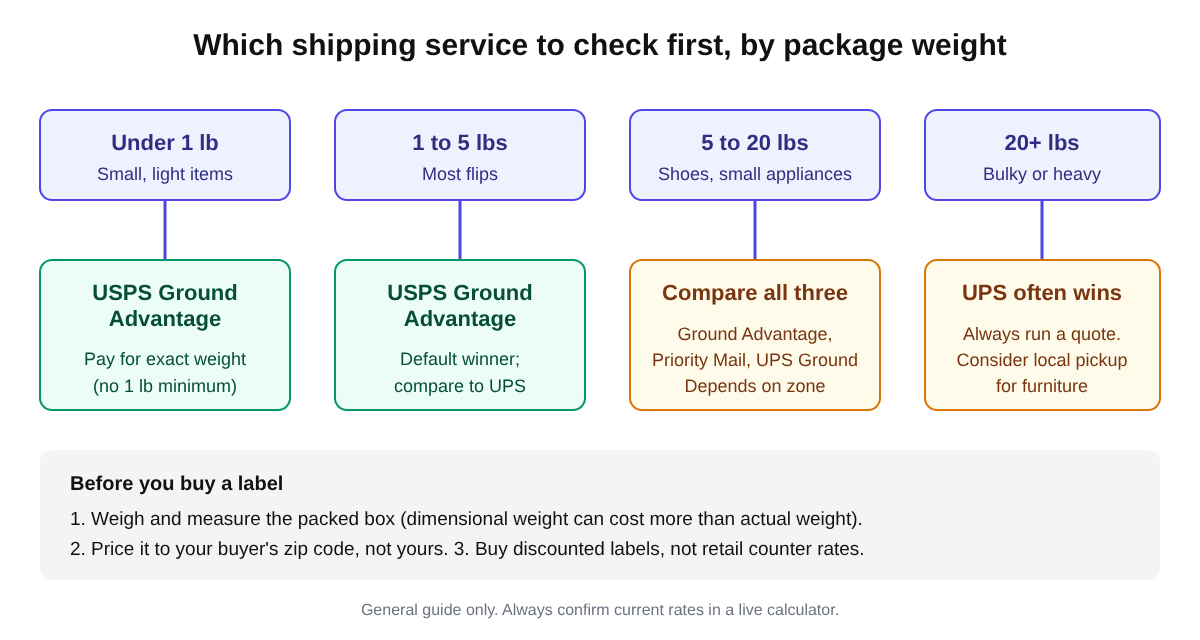
Under 5 lbs: USPS Ground Advantage
For light packages, USPS Ground Advantage at discounted commercial rates is usually the cheapest option. It also has no minimum weight, so you pay for what the package actually weighs. Priority Mail bills at a 1 lb minimum, which makes it a poor fit for a light hoodie or a video game.
This is where most flips live: clothing, small electronics, collectibles, books, and trading cards.
5 to 20 lbs: Compare Everything
This is the gray zone. Shoes in a heavy box, a stand mixer, or a pair of speakers can come out cheapest on Ground Advantage, Priority Mail, or UPS Ground depending on the zone. Priority Mail flat rate boxes only win when your item actually fits the box without wasted space.
Don’t pick a favorite. Run a quote on all three for your top few destinations.
20+ lbs: UPS Often Wins (or Don’t Ship at All)
Once you get heavy, UPS frequently beats USPS. Still, a 40 lb item shipped across the country eats margin fast. For furniture, weights, and big appliances, local pickup is usually the more profitable move. If you flip big items, our guide to flipping furniture for profit covers how to price local-only listings.
Step 2: Stop Paying Retail Rates
This is the biggest, easiest win. The price you see at the post office counter is retail. Discounted commercial rates are available to anyone through shipping software, and one comparison estimates retail counter purchases cost 15 to 30 percent more on most weight bands.
Where to buy discounted labels:
- Pirate Ship: Free to use, with no monthly fees or minimum volumes, and access to discounted USPS and UPS rates. Popular with small resellers because there’s nothing to commit to.
- Shippo and similar tools: Useful if you want integrations with multiple sales channels.
- Built-in marketplace labels: eBay, Poshmark, Mercari and Depop all sell labels at their own rates, which are sometimes competitive for typical sizes. Compare before you assume they’re best.
A good habit: before you buy a label, check at least two sources. It takes about 30 seconds.
A quick example
Say you sell a pair of sneakers for $90. You paid $35, eBay-style fees take around $12, and shipping is your variable.
- Retail counter label: $15, leaving about $28 profit.
- Discounted online label: $10.50, leaving about $32.50 profit.
That’s roughly $4.50 more per sale. Over 20 sales a month, it’s $90 you didn’t have to earn again. (Example numbers are illustrative. Actual rates vary by weight, size and zone.)
Step 3: Beat Dimensional Weight
Carriers don’t just charge by weight. They also charge by size. If your package is big but light, you pay for the space it takes up. This is called dimensional weight, and it’s the trap that catches new resellers shipping things like pillows, jackets, or toys.
A July 2026 change lowered the dimensional weight divisor from 166 to 139 for USPS and UPS, so oversized-but-light boxes now cost more than they used to. Check your carrier’s current rules before assuming old habits still work.
How to fight it:
- Use the smallest box that fits. A box that’s two inches too big can bump you up a price tier.
- Use poly mailers for soft goods. Clothing doesn’t need a box.
- Compress and fold. Vacuum bags and tight folding can cut volume dramatically.
- Don’t over-pad. Protect the item, but skip the mountain of bubble wrap.
- Keep a size chart. Note your standard box sizes and their typical shipping costs, so you can quote buyers quickly.
Step 4: Know When to Offer Free Shipping (and When Not To)
Buyers love free shipping. But “free” doesn’t mean it costs you nothing.
- Free shipping works when the real shipping cost is small and consistent, like a paperback or a phone case. Bake the cost into your price.
- Buyer-paid shipping works when costs vary a lot by distance or the item is heavy. You don’t want to eat the difference on a cross-country sale.
- Local pickup only is the smartest option for bulky items, and it also removes shipping scam risk. For safety tips when buyers are far away, read our guide to avoiding online scams.
If you’re selling on Facebook Marketplace or Craigslist, remember that shipping is usually optional. Many of your best flips will be local sales where you pay nothing to ship.
Step 5: Protect Your Profit with Smart Insurance and Tracking
A cheap label isn’t cheap if the package gets lost or damaged and you refund the buyer.
- Always use tracking. It’s your proof of delivery if a buyer disputes the sale.
- Check what coverage is included. Sources disagree on how much coverage comes built in for Ground Advantage, so verify in your label flow rather than assuming.
- Insure higher-value items. Electronics and collectibles are worth the extra dollar or two.
- Take photos before you seal the box. Quick pictures of the item and packaging help if there’s a damage claim.
Your Shipping Checklist
Before you buy a label, run through this list:
- Weigh and measure the packed item.
- Pick the smallest suitable box or mailer.
- Check Ground Advantage first for anything under 5 lbs.
- Compare at least two label sources.
- Price to the buyer’s actual zip code.
- Add tracking, and insurance if the item is valuable.
- Log the shipping cost for your records. It’s deductible, so it also matters at tax time (see our reseller taxes guide).
The Bottom Line
The cheapest way to ship packages isn’t one magic carrier. It’s a small system: right service for the weight, discounted labels instead of retail, the smallest box you can get away with, and local pickup for anything bulky.
Get that system in place once and you’ll keep more of every flip, without changing a single thing about what you buy or sell.
And the fastest way to make shipping worth worrying about is to flip more items. Flipify sends instant alerts for new underpriced listings on Facebook Marketplace, Craigslist, Kijiji and more, so you can find the next deal before anyone else does.