

Reseller Taxes: What Flippers Actually Owe in 2026
You found a deal, flipped it, and pocketed $100. Great. Then tax season shows up and the questions start. Do you report that? What about the stuff you sold at a loss? Is the 1099-K threshold a free pass?
Here’s the short version of reseller taxes: profit from flipping is income, whether or not anyone sends you a form. The good news is that you only pay tax on profit, not on everything you collect, and a handful of habits will keep the bill small and the stress lower.
This is general information, not tax advice. Rules vary by state and by situation, so check with a tax professional before you file.
Is Flipping Income Taxable?
Yes. The IRS expects you to report income from selling items for a profit, whether it’s $50 or $50,000. Reselling on Facebook Marketplace, eBay, Craigslist or Kijiji doesn’t change that.
There is one common exception worth knowing. If you sell your own used household items for less than you paid, that’s generally a personal loss, not income, and you typically owe nothing. A bargain-bin couch you flip for more than you paid is different. That’s profit, and it counts.
Hobby vs. business
If you flip occasionally, you might be a hobbyist. If you flip regularly, hunt for deals on purpose, and aim to make money, you’re running a business. Most serious flippers are in the second group.
That matters because business income goes on Schedule C, and you can deduct business expenses against it. Hobby income gets far less favorable treatment.
The 1099-K Threshold in 2026 (and Why It’s Not a Loophole)
Payment platforms report sales to the IRS on Form 1099-K. The reporting threshold has bounced around in recent years. For 2026, reporting follows the older rule: more than $20,000 in gross payments and more than 200 transactions, after legislation reversed the $600 floor.
Here’s the catch. That threshold only controls whether a platform sends you a form. It doesn’t control whether your income is taxable.
- Sell $15,000 of inventory across 50 listings? No 1099-K, but you still report your profit.
- Receive a 1099-K for gross sales of $25,000? That’s gross, not profit. Your costs come off the top.
If a form shows up that overstates what you made, don’t panic. You report the full amount, then subtract your cost of goods and expenses to land on real profit. This is exactly why knowing your profit margins matters before tax time, not after.
How Profit Gets Calculated
Tax is based on net profit, not on what buyers paid you. The formula is simple:
Sale price − item cost − selling fees − supplies − travel = taxable profit
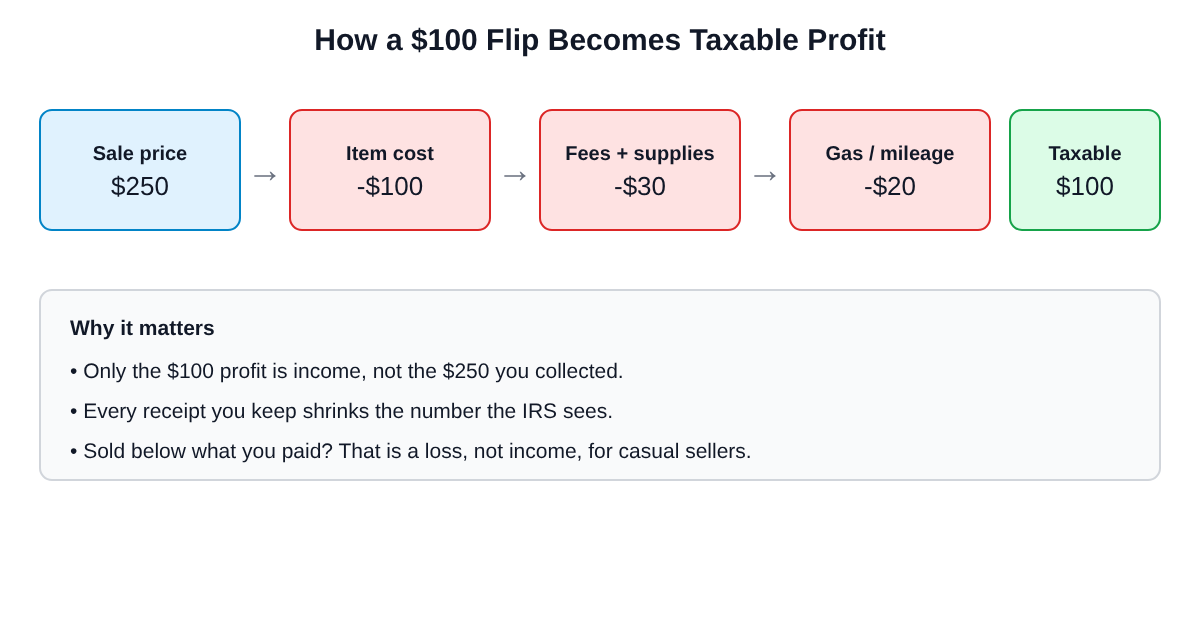
In that example you collected $250 but only $100 is taxable. Every legitimate expense you can document is money that never gets taxed.
Expenses flippers commonly deduct
- Cost of goods: what you paid for the items you sold.
- Platform fees: eBay final value fees, payment processing, boosted listings.
- Shipping and packing: boxes, tape, bubble wrap, postage.
- Vehicle use: business mileage for sourcing runs and drop-offs (the IRS publishes a standard mileage rate each year).
- Repair and cleaning supplies: paint, hardware, cleaners, fabric.
- Tools and software: listing apps, scales, a label printer, and yes, a deal-alert subscription used to source inventory.
- Storage: a rented unit or the business-use portion of a home workspace, if you qualify.
Not sure which sourcing tools are worth the cost? Our roundup of the best reseller apps is a good place to start.
Self-Employment Tax: The Surprise Most New Flippers Miss
Income tax isn’t the whole story. If your net earnings from self-employment reach $400 or more, you generally owe self-employment tax too. It covers Social Security and Medicare, and the combined rate is 15.3% on most net earnings.
That’s on top of regular income tax. It’s the number that surprises people most their first year, because nothing was withheld along the way.
A practical rule: set aside a slice of every profitable sale as you go. Many resellers park 25–30% of net profit in a separate savings account and adjust once they see their real numbers. If you expect to owe a meaningful amount, you may need to make quarterly estimated payments to avoid underpayment penalties.
Sales Tax: A Separate Question
Income tax and sales tax are different obligations.
- Online marketplaces like eBay and Etsy now collect and remit sales tax for most states on your behalf under marketplace facilitator laws.
- Local cash sales (Facebook Marketplace pickups, garage sales, Craigslist) are less clear-cut. Some states expect registered sellers to collect sales tax on in-person sales.
- Buying to resell: some states let registered businesses buy inventory tax-free with a resale certificate. Thrift stores and private sellers generally won’t honor one, so this matters mostly for wholesale buying.
Check your state’s department of revenue website. Rules differ widely, and a ten-minute read now beats a notice later.
A Simple Record-Keeping System
Good records are what turn “I think I made about $3,000” into a number you can defend. You don’t need fancy software, just consistency.
- Log every purchase the day you buy it. Date, item, price, where you got it.
- Log every sale the day it closes. Date, platform, sale price, fees.
- Save receipts. Snap a photo of each one and drop it in a folder labeled by month.
- Track mileage. A notes app entry per sourcing trip works fine: date, destination, miles.
- Keep business and personal money separate. A dedicated checking account or card makes year-end painless.
- Reconcile monthly. Fifteen minutes on the first of the month beats a frantic weekend in April.
Most flippers already track purchases to price items correctly, so you’re partway there. If you haven’t built that habit yet, start with our guide on how to price items for resale.
The cost-basis trap
The most common mistake is forgetting what an item cost. If you can’t prove what you paid for a flip, you may end up reporting the entire sale as profit. Snap a quick photo of the price tag or save the payment confirmation when you buy. Sourcing through an alert app also leaves you a timestamped record of the original listing price, which helps.
Common Mistakes to Avoid
- Assuming no 1099-K means no tax. The form is a reporting tool, not a permission slip.
- Mixing personal and business items. It muddies your records and invites questions.
- Skipping the tax set-aside. Spending every dollar of profit, then getting hit in April.
- Throwing away receipts. Keep records for at least three years.
- Deducting everything. Aggressive or made-up deductions are riskier than a slightly higher bill.
Your Reseller Tax Checklist
- Decide whether you’re flipping as a business (most active flippers are).
- Open a separate account for flipping money.
- Log purchases, sales, fees and mileage as they happen.
- Set aside 25–30% of net profit for taxes.
- Check your state’s sales tax rules for local sales.
- Book an hour with a tax professional once, to set up your system.
The Bottom Line
Reseller taxes feel intimidating mostly because nobody explains them. Strip it down and the rule is simple: you’re taxed on profit, so the better your records, the lower your bill. Build the tracking habit early, keep your receipts, and treat tax money as something you never really owned.
Then get back to the fun part: finding underpriced listings before anyone else does. Flipify sends instant alerts for new deals on Facebook Marketplace, Craigslist, Kijiji and more, so you spend your time flipping and not scrolling.